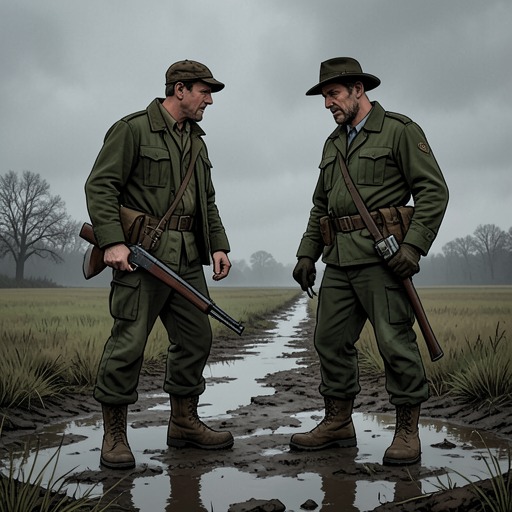
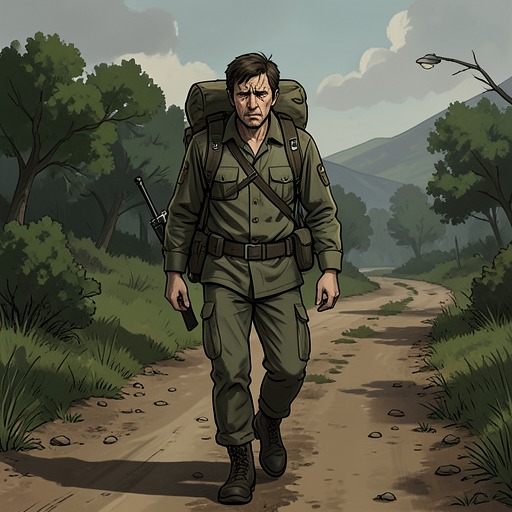
Sergeyich—Petro friendship
Grey BeesThe friendship between Sergey Sergeyich and Petro is marked by separation, worry, and a sudden, joyful confirmation of life. When Petro finally calls, Sergeyich learns that the wounded soldier has returned home after hospital treatment and is limping; he answers with undisguised relief, then turns the conversation to another dead man whose body had lain in the field. Their exchange ends with an invitation postponed until the war is over, making friendship and homecoming promises audible against a landscape still defined by danger.
Separation and the unanswered call
The connection is first colored by uncertainty. Sergey Sergeyich has discovered a grenade in a hive and, back in his car, takes it from his pocket and sets it on the passenger seat. Thinking of the soldier, he wonders what became of him—whether he is dead or injured—and calls Petro. Long beeps sound in his ear for a couple of minutes, but no conversation follows. The unanswered call leaves the question of Petro’s survival open while the grenade beside him makes the threat of death physically present.
The call’s delay shapes the later moment of recognition. After sitting for about five minutes and settling himself in the evening’s peaceful silence, Sergey Sergeyich hears his mobile ring. He assumes it is Galya calling, and reluctantly checks the screen; the caller is Petro. In a few beats, expectation gives way to astonishment: the person whose fate he had been unable to establish is reaching him himself.
The call and Petro’s recovery
Sergey Sergeyich brings the phone to his ear and, instead of a conventional greeting, bursts out, “Alive! You’re alive, brother!” Petro confirms that he is alive and back home after the hospital, though he is “Limping around.” His voice, like Sergey Sergeyich’s, cannot conceal its joy. The exchange makes recovery concrete but incomplete: Petro has survived and returned home, yet his limp records the injury he is still living with.
Sergey Sergeyich answers that Petro’s limping is cause for gratitude because it means he is alive. The line turns a visible limitation into evidence of survival, without suggesting that the injury has vanished. Asked how he is, Sergey Sergeyich says he is not bad and is going home too. The two men are thus briefly linked by a shared direction—home—even as Petro is already back there and Sergey Sergeyich is still on the road.
A second question about the dead
The mention of home shifts Sergey Sergeyich’s attention back to the unnamed man killed in the field. He asks Petro whether the body is still there. Petro says it has been taken away before the other side could bomb them to bits: members of Cargo 200 recovered the man and took him back to his family. He adds that the dead man was a volunteer from Dnipro.
The news matters to Sergey Sergeyich, who sighs that it is good the body was recovered and returned. His concern extends beyond confirming Petro’s own survival: he also wants to know whether the dead have been removed from the exposed field and brought back to their families. The conversation holds these outcomes apart without erasing either—Petro is alive and recovering, while the volunteer’s return is a burial journey undertaken by others.
The postponed visit and the road home
Having heard Petro’s news and learned what happened to the dead man, Sergey Sergeyich invites him to come and visit when he has time. Petro laughs at the suggestion because the war is still on. Sergey Sergeyich immediately revises the invitation: he means when the war is over. Petro promises that he will come then. Their future meeting remains conditional, not scheduled; its possibility rests on an end to a war that continues to govern where they can go and when.
After the call, Sergey Sergeyich sets off in his green Lada with the trailer. The headlights pick out the start of the dirt road; after driving two or three hundred metres, he stops to check the trailer hitch, then gets back behind the wheel and continues across the rough, seemingly endless field. The beams touch the land on either side, but he cannot make out what is growing there—and does not want to. The closing movement carries his homeward journey forward while the promised visit remains in the future. Their friendship is expressed in the call’s first astonished greeting, the care with which Sergey Sergeyich asks after both a living friend and a dead stranger, and the promise to meet when wartime separation permits it.